10 April 2011

The Wire: television-as-novel or television-as-video-game?

The Wire, as a select few of you may know, sits at the very tippy-top of the list of my favourite television programs -- hell, my favourite anythings -- of all time. I, alongside the creator of the show, David Simon, would usually say that it transcends pretty much anything else attempted on serial television to be more like an epic novel in its structure. It is so densely packed with well-rounded characters and situations that compound and build towards exhilarating climaxes, and it takes place on a huge canvas, trying to get at nothing less than the hum and flow of an entire city -- the gritty, real-life port metropolis of Baltimore, MD. Perfectly acted, written, paced, directed, with a cynical, biting sense of humour that deepens its serious, often violent portrayals of urban life, The Wire is especially novelistic in the way its episodes resemble chapters of a book, and the seasons are like books in a larger epic novel.

But in his unconventional yet illuminating and spot-on essay, Jason Mittell argues that The Wire can just as easily, if not better, be compared to the video game genre. He uses a comparison that even further illuminates why I responded so well to The Wire, likening it to an amalgam of Will Wright's simulation computer games Sim City and The Sims -- big-time favourite time-passers of mine from childhood. The attempt to capture all the little things that make a city tick particularly link it to the former game, and the focus on characters and their decisions with regard to the institutions in which they find themselves (the drug trade, police, dock workers, school teachers, city councilpersons) connect it to the latter. Furthermore, the seasons are like "replays" of a game, in that there are certain similarities in plot but with little twists that alter the game. The characters also frequently mention games (especially with regard to their different lines of work) in the show's dialogue.

At any rate, it's certainly an interesting way of viewing the show, and is a seemingly out-there comparison that has surprising merit. The essay is definitely worth a read if you've seen, or are even thinking about seeing, The Wire.

07 March 2011

This newfangled music: Are the Grammys better at being hip than the Oscars?

Now, if you know me, then you already know this. If you don't, let me lay out a few things on the table: I'm not much of a hip music lover who is down with all the latest trends on the underground or the mainstream music scene. I'm more a movie guy, or even a TV guy, than a music guy. I don't own an iPod or an MP3 player of any sort. I don't even have a portable CD or tape player. All my music listening is done right here on my laptop, or in my car, or on whatever radio station happens to be playing at work. What few CDs I own are primarily greatest hits compilations from classic rock legends from the '60s, '70s, and (to some extent) the '80s... and the Smashing Pumpkins (they didn't really fit into those other headings, but I love 'em). Oh, and Muse. My most elaborate collections come from the oeuvres of the Beatles and Rush, and I own a couple CDs here and there from Barenaked Ladies. All of which is to say: I'm vaguely aware that more contemporary artists/musicians/pre-programmed Auto-tuned pop robots like Ke$ha, Willow Smith, Justin Bieber, John Mayer, Drake, and the Black Eyed Peas; however, most of the time, I'll have a hell of a time pointing out whether a song is the product of one of these or differentiate between them.

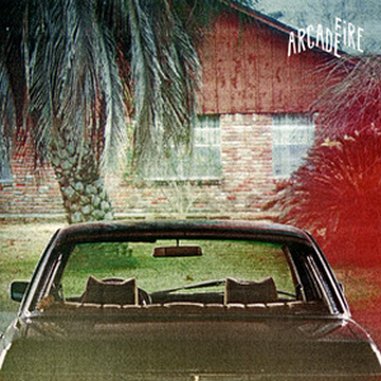
Every once in a while, however, I'll try to at least make an effort to understand what most people my age listen to, at which point I will head down to my local music store (nothing too niche; generally HMV) and procure some of this newfangled music. I went on a bit of a spree to that end of late, purchasing Brothers from the Black Keys, The Suburbs from Arcade Fire, and Fantasies from Metric -- mainly on the strength of one overplayed single on the radio that did a particularly good job of not making my ears bleed or making me launch for the "seek" button. All of which is to say, I do like some music out there right now.

The Black Keys album has a groovy, hard beat to it that's infectious even if some of the songs pick up more steam than others. ("Tighten Up" was an apt choice for a single, but I rather enjoy "Everlasting Light" and "Howlin' for You.") In addition, for those who like to judge books (and CDs) by their covers, the Brothers cover is one of the best covers I've come across for its witty bluntness.


Go ahead. Try and not chuckle.

Metric is just as toe-tappingly good, if not more so. I freaking loved "Stadium Love" so much that after buying Fantasies primarily because of it, I discovered it also contained songs that had flittered onto the radio previously that I had actually quite enjoyed, and now enjoy even more in their proper context. The lead singer's voice is downright lovely; try and not be a little captivated by it. And the songs maintain a boppy, pulse-pounding rhythm while amazingly not sacrificing the wit of the lyrics, which remain thoughtful and playful in equal measure. Apparently, their previous work was even better, as some have suggested Metric have sold out with Fantasies. If this is the case, I'd be OK with some more artists selling out, since it actually gets me to pay attention to them and discover what others have already known.


Best of all was The Suburbs from Arcade Fire, which I bought after overhearing how it (rather surprisingly) won Album of the Year at the Grammys and having previously enjoyed the odd song from the Montreal-based group. The Suburbs is a real album, in the sense it once meant (or maybe I'm just projecting my idea of what it should be): a group of songs linked tightly together thematically and sonically but that are all strong enough to stand on their own. The album starts off with an exhilarating bang and never really lets up, although it does shift sound styles from more snappily acoustic to the soaringly orchestral to the percolatingly (is that a word? it should be) wondrous electronic. It is a bona fide masterpiece, fresh and eclectic and serious and fun. I'm not overly familiar with who else was nominated at the Grammys and their particular strengths and weaknesses, but this seems like a dynamite choice to win the biggest music award of the year.

Which brings me to the other point of this post: the relative merits of awards ceremonies to accurately express and capture the atmosphere of their respective media (music or films) that particular year. People say negative things both about the Grammys (the biggest and flashiest of the music awards) and the Oscars (the biggest and flashiest of the movie awards). The Grammys have far too many categories to the point where some of the awards are basically useless; I'm reminded of the Simpsons episode wherein Elton John meets Homer Simpson and generously gives him one of his Grammys, which Homer considers a backhanded compliment and promptly throws it in the trash. The Oscars are by now considered stuffy and out of touch with the youth and the cinematic trends of today; for Pete's sake, it took them until 2001 to have a category for animated films?! And they're egregiously overstuffed, with the worst-offending ceremonies taking almost four-and-a-half hours to fully unspool.


I didn't watch the Grammys this year, nor any year to my recollection. But the awarding of The Suburbs of the biggest award seems like a far wiser and simpler way of connecting with the current musical atmosphere while simultaneously valuing real quality than the similar attempts of the Oscars this year to appear fresh and in touch to movie lovers. As much as I liked The King's Speech, which took home the biggest Oscars of the night, it hardly wowed me in doing its particular thing to the extent that The Suburbs did. It was well put-together in most measurable aspects, particularly in the fields of acting and general art direction and technical competence. But while it can be admired and even stir some emotions, it never surprises or thrills. The Suburbs really does. The Social Network, the main competition to The King's Speech, really did, and had it won, we might not even be making this comparison right now. And while this last Oscar ceremony was shorter than some of the recent behemoths, its hosts, James Franco and Anne Hathaway, sometimes looked good but never really connected with the audience. In addition, only a few of the acceptance speeches really went anywhere interesting, and some of them went interesting places that left a nasty aftertaste in the mouth (see Melissa Leo).

This has been a lot of completely tangential, apples-to-oranges comparison. I really don't know whether the Grammys as a whole can be considered fresher than the Oscars, but both awards ceremonies certainly seem to be trying in that direction, to varying degrees of success, and with the once-mocked Grammys coming out, for now, on top -- according to my narrow view. While there is great music out there right now (as I have lately discovered), as well as great movies, awards shows only rarely tend to accurately honour them, being designed, by necessity, by committee. I guess we'll just have to wait and see whether my completely slipshod theory holds true in the coming years. For now: good work, Grammys.

20 February 2011

Oscar predictions ahoy!

It's that time of year, folks. One week left until the Oscars! And while I'm sure few in the general populace really care about that fact at all, and certainly don't care enough to get invested in making actual predictions about who is/should win the awards, I somehow still hold onto my traditional obsession despite all logic suggesting it's not such a big deal. At any rate, below I will take a look at the eight major categories, point out who I think will win (highlighted in green), who I think should win (highlighted in red), and if I think the winner is deserved, then I will highlight it in blue. (Hopefully, this jives with my layout. We'll see, I suppose.) I will also give reasons for my choices and say who I thought was brutally robbed of a nomination if I have particularly strong feelings about it. Cool? Cool. Let's get this train a-rollin'!

Best Picture

127 Hours
Black Swan
The Fighter
Inception

The Kids Are All Right
The King's Speech
The Social Network
Toy Story 3
True Grit
Winter's Bone


should have been nominated: This is actually pretty good. Maybe A Prophet? This ten nominees thing so far has meant that most of my favourites actually get in there, as my top four movies from last year are all among the nominees. So... cool.

Like I said, my four favourite movies of last year (Toy Story 3, The Social Network, The Kids Are All Right, and Winter's Bone) all scored a nomination, and 127 Hours and Inception was pretty darn stellar as well. The best of these was Toy Story 3, however, a timeless classic that proves indelibly the merits of animation, three-quels, and bright, beautiful multi-leveled big-budget entertainments that speak to folks of all generations. If I had my way, it would take down the formidable competition next Sunday. (As it is, it's certainly going to win Best Animated Feature.) Unfortunately, the odds are against it, as the Academy seems to like real people rather than 3-D playthings in their movies. Almost everyone has suggested this will be a race between the brainy Social Network and the heart-warming King's Speech. While I would be thrilled if The Social Network won, The King's Speech has just built up far too much momentum in all the other awards ceremonies so far for it to be derailed at this point. If you're into betting, you should be thinking, "Long live the king!" at this point.

Best Director

Darren Aronofsky, Black Swan
Joel and Ethan Coen, True Grit
David Fincher, The Social Network
Tom Hooper, The King's Speech
David O. Russell, The Fighter

should have been nominated: Christopher Nolan, Inception; Lee Unkrich, Toy Story 3; Danny Boyle, 127 Hours; Lisa Cholodenko, The Kids Are All Right... seriously, screw this category! I'd be OK with everyone except Fincher and maybe the Coens not being there.

David Fincher is so clearly the winner in this category that it's a good time to get your consolation cards to the other nominees in the mail, if you haven't already. While I do expect Tom Hooper's The King's Speech will take home the biggest award of the evening, I suspect the film's director will be seen as a bit too inexperienced to take this particular prize. And, really, I'm pretty OK with it, since The King's Speech succeeded almost entirely on the actorly strengths of Colin Firth and Geoffrey Rush... not so much on the competent but unexciting direction of Hooper. Fincher's film was perhaps the most lively, endlessly engrossing, timely, and smoothly directed of last year. Every touch, from the colour palette to the angles at which it was shot to the quietly unnerving musical score to the bravura showcase of rapid-fire dialogue, added to the overall effect. Fincher was economical and cunning in bringing off the zingy wonder of The Social Network with such little fat left on it to trim off. He will almost certainly win, and I'll be grinning like a schoolgirl when he does.

Best Actor

Javier Bardem, Biutiful
Jeff Bridges, True Grit
Jesse Eisenberg, The Social Network
Colin Firth, The King's Speech
James Franco, 127 Hours

should have been nominated: Leonardo DiCaprio in either Shutter Island or Inception

Another no-brainer of a category, at least in terms of who will win. Colin Firth is so handily going to take this that it's almost unfair to everyone else. I mean, really. It's almost harsh even having the other guys there. Firth's portrayal of the uneasy would-be king is truly towering work, effortless but never unimpressive. I thought Jesse Eisenberg certainly did comparably amazing work in The Social Network, with James Franco falling not too far behind. But it's Firth's night -- all the factors, especially that his film is a period piece about royalty, are so completely Oscar catnip -- and the man certainly deserves it.

Best Actress

Annette Bening, The Kids Are All Right
Nicole Kidman, Rabbit Hole
Jennifer Lawrence, Winter's Bone
Natalie Portman, Black Swan
Michelle Williams, Blue Valentine

should have been nominated: Kim Hye-Ja, Mother

Keep in mind I've only seen three of these five films, so please take my opinions with a grain of salt here. While Jennifer Lawrence was stunning in Winter's Bone, she's certainly too new, and a tiny bit outclassed, here to take home the trophy. Natalie Portman will pretty much certainly take home the statuette, and while I found her work to be basically the piercing, subtle, graceful, and compelling saving grace of the somewhat overbearing and cheesy Black Swan, she didn't quite (by like an inch) dominate her movie as thoroughly and winningly as did Annette Bening in The Kids Are All Right. Her Nic was the most fully formed female character (possibly the best character period) from last year, and this was due not only to the sparkling writing and loose-but-serious direction of Lisa Cholodenko and co-writer Stuart Blumberg, but by the whip-smart, committed, easy-going but emotionally complex work done by seasoned veteran Bening. While Portman certainly put on a great, flashier show in Black Swan, and I reckon the Academy will honour this, and was a worthy competitor, I liked the subtle and more grounded and more instantly identifiable, equally brilliant work done by Bening just a little bit more.

Best Supporting Actor
Christian Bale, The Fighter
John Hawkes, Winter's Bone
Jeremy Renner, The Town
Mark Ruffalo, The Kids Are All Right
Geoffrey Rush, The King's Speech

should have been nominated: Andrew Garfield, The Social Network; maybe Joseph Gordon-Levitt, Inception

This category is a bit tougher... thankfully. I do hate when it's a complete blow-out of a race. While my personal favourite is Mark Ruffalo from The Kids Are All Right -- a great, subtly surprising match of an actor's personality to a character's -- I'm not sure the Academy will quite agree with my reasoning... especially when he was surrounded by equally wonderful performers giving equally, and more, great performances. I'm thinking a horse race between Geoffrey Rush and Christian Bale, and since Rush has (unduly, in my view) been overshadowed by talk of Colin Firth in all the chatter about King's Speech, I think Christian Bale will pull a win here for his Method-complex work in The Fighter... and that will sit pretty darn well with me.

Best Supporting Actress

Amy Adams, The Fighter
Helena Bonham Carter, The King's Speech
Melissa Leo, The Fighter
Hailee Steinfeld, True Grit
Jacki Weaver, Animal Kingdom

Another tough category, although it might just be because I haven't put much thought so far into this particular race. But it's undoubtedly a solid line-up here: you may have noticed the lack of a "should have been nominated" section here. I'm at least somewhat of a fan of all of these choices, but I predict it will be a race between Melissa Leo and Hailee Steinfeld, both unbelievably vibrant in their particular roles in their particular movies. Since this is a category fairly well-known for its wild-card wins, (which begs the question of how I can even predict it at all, but shush) I think young Hailee Steinfeld might just have the chutzpah as well as the sincerity to pull off a win here. To be sure, she was the heart and soul of the Coens' rollickingly entertaining but occasionally detached Western revival. And I would be all for Steinfeld, until I saw Animal Kingdom and thrilled to the way Jacki Weaver slipped so casually between lovey-dovey mother and cruel, conniving jungle cat. It was downright electrifying, but unfortunately too few people saw this movie, ultimately, for it to register as much more than a blip on the Academy's radar.

Best Adapted Screenplay
127 Hours, Danny Boyle and Simon Beaufoy
The Social Network, Aaron Sorkin
Toy Story 3, Michael Arndt; story by John Lasseter, Andrew Stanton, and Lee Unkrich
True Grit, Joel and Ethan Coen
Winter's Bone, Debra Granik and Anne Rosellini

should have been nominated: The Ghost Writer

Pretty OK with all these nominees, once again. Awesome! But c'mon... as much as I liked all of these movies script-wise, particularly The Social Network and Toy Story 3, Aaron Sorkin has this one in the figurative bag. His script was a thing of beauty, unspooling streams of stylized, fully modern patter without ever letting his tightly knit story go off the rails. He will win, and by the Flying Spaghetti Monster, so he should.

Best Original Screenplay

Another Year, Mike Leigh
The Fighter, Scott Silver, Paul Tamasy, and Eric Johnson; story by Keith Dorrington, Tamasy, and Johnson
Inception, Christopher Nolan
The Kids Are All Right, Lisa Cholodenko and Stuart Blumberg
The King's Speech, David Seidler

should have been nominated: Fish Tank

I direly wished I could have seen Another Year before this. Ah well, life is a bitch. Frankly, this could very well be another chance for the Academy to shower its gold upon The King's Speech, but I predict they will take this as their opportunity to honour Inception and its mind-boggling chutzpah. I, too, was pretty darn impressed that anyone could even write something like this in a filmable fashion, so undoubtedly Inception would be a shrewd choice to win, and it probably will win here. However, The Kids Are All Right was not only smartly written, but full of the type of heart and well-rounded characters that, for all its invigorating mind games, Inception didn't quite pull off. I think Cholodenko and Blumberg's achievement was just a tad more towering than the formidable Nolan's. I want to stress that I'd be OK with a Nolan win, though, quite OK; a bit less OK with a King's Speech win, though that is a definite possibility.

Other categories? I think it would be a hoot and a most deserving win if Exit Through the Gift Shop took Best Documentary Feature, though the sobering, intellectual, and dazzlingly put-together Inside Job will probably pull ahead, not without merit. Toy Story 3 will undoubtedly win Best Animated Feature, as it damn well should. I would be thrilled if The Social Network track by Trent Reznor and Atticus Ross won Best Original Score, but it's facing stiff, strong competition from the likes of Alexandre Desplat, the likely winner, Hans Zimmer, and John Powell's soaring work on How to Train Your Dragon. And on a rather anticlimactic note, I hope Inception wins the two sound awards because, well, it sounded fucking amazing in theatres.

Agree? Disagree? Want to talk and ramble on? Feel free now to do just that. Happy Oscars, and I'll see you on the other side! (Unless I decide to do a live blog of them again like last year... Hmm...)

25 January 2011

Gates of Heaven (Errol Morris, 1978); Days of Heaven (Terrence Malick, 1978)


I recently watched some truly "heavenly" films, if you catch my drift (and my ridiculously obvious pun). It seems my Netflix viewing has become oddly patterned. First off, I watched Gattaca and then Dark City, a pair of dark, serious, almost convoluted sci-fi movies. Then, I watched two great (albeit for completely different reasons) French movies, The 400 Blows (which earned an immediate spot on the best-of-all-time list) and Caché (which thrilled me even more the second time around -- I had seen it before, a while ago). And now, two movies in the same day with "heaven" in the title. And not only that, but both were released in 1978. My mind works in mysterious ways, sometimes, my friends.

Gates of Heaven was a quirky documentary from Errol Morris about the owners and customers of a pet cemetery. Despite this completely not-promising-at-all set-up, the movie is profoundly philosophical and moving, with plenty of points to make about life and death, companionship, the relationship of pets and their owners. Strangely captivating stuff that could have been played for laughs, yet remains sincere throughout. Roger Ebert famously went nuts over this movie, at times including it in his ever-changing lists of the 10 best movies of all time. While I think Hoop Dreams has this one beat over all, Gates of Heaven is still one of the best documentaries I've seen in quite some time. A

Days of Heaven is pure Terrence Malick, and probably the finest, loveliest, simplest distillation of his trademark style (reliant on poetic narration and eye-popping, nature-oriented cinematography) out there. It's an easygoing story about pioneer/farm life and a particularly strange yet strangely beautiful love triangle. I loved the crap out of The New World and The Thin Red Line, with a few reservations, and if you did, then I have no hesitation in recommending this. Richard Gere, who often strikes me as a bit too smarmy, has rarely if ever been more effectively used than he is here; dare I say, he has a lighthearted charm here that is downright infectious.

I found the film oddly distracting, though, for a couple of silly and personal and esoteric reasons. (Hey, I told you up there that this blog could be esoteric sometimes.) It was filmed right around where I live, and throughout much of the film, I was taken out of the narrative, through no fault of the director's, by seeing things and landscapes with which I was intimately familiar. Particularly distracting were the final scenes, featuring the High Level train bridge in Lethbridge which I drive past everyday on my way to work, and Heritage Park in Calgary, which obviously negated some of the historical impact of it for me. I mean, I know it's supposed to be set in 1910s-era Texas, but gosh-darn-it, I know it's not really there because I know these places too well. (I mean, look at that still up there. Seriously. Those are the god-damned Foothills in Alberta with the god-damned Rocky Mountains off in the distance.) It ruined some of the otherwise magnificent flow of the film and, especially, the temporal and geographic reality it tried so hard to create.

But this is really an odd problem for someone to have with a film, and I fully admit my bias here. This is still a wonderful film, probably the best introduction someone could want to the particular cinematic genius of Malick. A-

24 January 2011

The 3-D debate rages on...

A particularly interesting post from Roger Ebert, a man, in my opinion, of many interesting posts.

I've enjoyed the 3-D technique from time to time, finding it particularly effective in Avatar, Coraline, and a couple other animated movies, off the top of my head. It can be done well, if incorporated into the original story and vision of the movie, but do the pros outweigh the cons? Is it really worth the extra cost to see something like Green Hornet in an extra dimension, even if that dimension often tends to blur out the other two? Especially odious are films where the technique has obviously been slapped on in haste: for example, Clash of the Titans.

Walter Murch, an incredibly esteemed film editor and sound designer, who worked on some of my favourite movies, notably Apocalypse Now, goes further, and suggests in the above-cited article that the 3-D technique is at odds with science in terms of our visual perception. We have simply not evolved as humans to percieve images in this way, with our eyes focusing at one point and converging on another. It's just weird and difficult, like, to use Murch's example, patting your head and rubbing your stomach at the same time. It can be done, sure, but it's challenging and frustrating.

It's merely one opinion among many, but Murch is certainly an expert in this field, and would have to deeply understand how people watch movies in order to have achieved the level of success he has in his career. So, it's worth some serious consideration. Then again, people have been known to make some scientifically baffling decisions now and then, so the 3-D trend might just rage on.