Mellifluous musings on food, movies & pop culture; adventures in vegetarian cookery, with recipes to boot!
06 January 2013
Les Misérables (Tom Hooper, 2012)
Based on a big, bombastic, popular, and really, really long-running musical, which in turn is based on a historical novel from Victor Hugo set in the miserable time of early-19th century France, this is a movie where nothing is small and everything is meant to feel like a cannonball to the stomach in terms of how it tries to blast feelings out of you. For a brief moment early on, this approach actually works like a charm, and we filmgoers can get a welcome taste of the dramatic impact of the play. Anne Hathaway is absolutely spellbinding as Fantine, a downtrodden woman trying to save up for her young child's future (the father is, of course, out of the picture) driven to prostitution and even selling her hair and teeth. The most powerful moment in the movie is her raw and passionate rendition of "I Dreamed a Dream." Unfortunately, this leaves about two, largely Hathaway-less hours left before the movie grinds exhaustingly to its conclusion.
This is truly monochromatic, disjointed, underdeveloped, overwrought stuff, shot by director Tom Hooper & co., for some reason, at extreme close-ups or at 45-degree angles that I guess is meant to heighten the gritty realism and intimacy of it all but instead makes everything just feel intrusive or look like a drunken blur. It's the kind of movie where consistency and plot development fall by the wayside in favour of big, dramatic, emotional moments that, if you actually take a moment to look at them, don't often make a lot of sense or amount to more than a hill of beans. What is the ultimate basis of the rebellion that dominates the second half of the movie? Vague teenage angst? None of that revolutionary spirit rang true in this film version. Why is Javert so singularly focused on capturing Jean Valjean? Doesn't he have other criminals to tend to? Why is Valjean so self-flagellating? The man is a (one-dimensional) saint; don't be so hard on yourself! Why are the broad comic stylings of Sacha Baron Cohen and Helena Bonham Carter, as crooked inkeepers, so arbitrarily sprinkled in with the action? They seem to hail from a different movie altogether. Why does everyone seem to die not based on any sort of actual disease or natural cause but mainly when the storytellers feel like we are ready again for a big cry? It's just pure, unbridled (and largely ineffective) manipulation.
Honestly, the music isn't even very good, aside from the aforementioned "I Dreamed a Dream" and "Master of the House," which is kind of fun and bouncy--although Hooper ruins even that number with his antic framing techniques. This is a problem, indeed, with the original stage production, although the stage is better suited for this enterprise's endless crescendoes."The ABC Café—Red and Black" falls particularly flat; it's more a blunt object than a song, with little musical variety or nuance to it, just pointed stabs of "red!!!" and "black!!!" that quickly grow tiresome.
On the plus side, Hugh Jackman, always a generous, winning actor, throws himself into the role of Jean Valjean with admirable aplomb--it's a solid effort. The attractive Samantha Barks as Eponine and Eddie Redmayne as Marius sing beautifully and have some nice moments. Russell Crowe, however, just looks pained and uncomfortable as Javert; it was actually excruciating to watch this normally talented man struggle through this Broadway-style emoting.
Aside from a few poignant moments dominated by the showstopping Hathaway, Hooper's Les Misérables is a glossy, in-your-face, aggresively ingratiating endeavour that is never nearly as powerful as it wants to be. This is a movie that tries way too hard to hit those high notes (both musically and emotionally) without developing its characters or telling its story clearly enough to actually earn the impact it's so eagerly gunning for. At two-and-a-half long hours of vague, often incoherent misery and revolution and teenage angst and romance, it grows so excruciating that ultimately it's the audience who become les misérables. C-
06 May 2012
“Gerrying the Rendezvous:” Spatialized Time and the Elusive Search for the Point in the Cinema of the Desert
-Scott
----------
There is such an ambiguity at play in the early moments of the previously mentioned shot from Lawrence of Arabia, which Roger Ebert’s description of the moment emphasizes and which is worth quoting at length for the metacinematic implications it uncovers:
- There is a moment in the film when the hero [. . .] has survived a suicidal trek across the desert and is within reach of shelter and water—and he turns around and goes back, to find a friend who has fallen behind. This sequence builds up to the shot in which the shimmering heat of the desert reluctantly yields the speck that becomes a man—a shot that is held for a long time before we can even begin to see the tiny figure.
This simple description leads directly into a somewhat more profound discussion of the origins of cinema. Ebert’s mention of “the speck that becomes a man” in Lawrence of Arabia recalls Mary-Anne Doane’s discussion of the point as the essence of the photograph, which is itself the essence of cinema. Doane’s theory responds to Henri Poincaré, who argued for the non-actualizable-existence of the point but who saw its usefulness as a geometrical abstraction, and Etienne-Jules Marey, who, in “contracting the image to a point,” while not his intention, provided “the condition of possibility [. . .] for cinema” (Doane 217). Doane argues, however, that “in the cinema, the image as point is precisely what the spectator does not see, what is not accessible. Just as the line conceals its ontological dependence upon the point, the projected illusion of continuity in cinema hides the independent existence of the photogram” (217). Cinema is particularly crafty, in other words, about concealing its own origins; the point in Lawrence of Arabia, therefore, cannot remain a point for long. It must move from the abstract to the concrete form of the man (or else be lost or scattered, which, as we will see, is precisely what occurs in Nostalgia for the Light and Gerry), just as cinema as a whole arises from the photograph by transforming its stillness to motion and its point to linearity. Ebert’s talk of “becoming” also brings to mind Henri Bergson, who asserts that reality is experienced as a “continuity of becoming” rather than “a discontinuous multiplicity of elements, inert and juxtaposed” (171). The same continuity is also essential to cinema, as we can see from Lawrence of Arabia as well as the following examples. Cinema cannot persist in stasis, but must, along with the point, become.
One scientist in Patricio Guzman’s documentary Nostalgia for the Light brings up the fact that light does not travel from its source to our eyes instantaneously. Light from the sun, for example, takes eight minutes to arrive to earth. One thus always sees an image at least slightly mediated by time; everything has past by the time we see and process it. This scientific fact should serve to destabilize even the securest notions of present. We are always involved in a process of becoming and never just are. The point, as posited by Marey and questioned by Doane, cannot, therefore, really exist in a Bergsonian view of the world that entails continuity. Marey aimed paradoxically to study movement by ceasing it from moving, isolating it via chronophotography into discrete slices of recorded time. While this allowed Marey to determine extremes of movements that might not have been readily apparent before the advent of photography, as well as a way to chart the trajectory of a moving object and calculate speed, his phrase “characters of a movement” seems disconnected from reality (54). These “characters of a movement” are precisely what Thierry de Duve had in mind when he explored “the paradox of the unperformed movement and the impossible posture” (115). De Duve notes that there can be no stasis in movement, reality, or events:
- Either the photograph registers a singular event, or it makes the event form itself in the image. The problem with the first alternative is that reality is not made out of singular events; it is made out of the continuous happening of things. In reality, the event is carried on by time [. . .] the discus thrower releases the disc. In the second case, where the photograph freezes the event in the form of an image, the problem is that that is not where the event occurs. (115-16)
Bergson, de Duve, and Doane all seem to be in agreement that there is a fundamental disconnect between the lived experience of time and what the photographic image makes of it; the photograph puts a disturbing halt to temporal continuity and cannot depict events because events proceed and are not locked within static images. Perhaps this is why cinema—even cinema that takes as its subject the clear, uniform space of the desert, where time seems most free to exert its presence without man-made or even much natural distortion—struggles to find its way back to the point (in its many manifestations); there never really was one (in more than an abstract sense). The desert, it seems, can become as temporally and physically obscure as any more topographically complex landscape when it enters the cinematic realm, which creates a mirage effect that often serves to obscure the point in its numerous instantiations.
In Nostalgia for the Light, the desert is established at the outset as an ideal vantage point from which to look in at what lies beneath the surface of the earth, and to look far out at the vastness of the cosmos. The Atacama Desert in Chile, with its clarity and spaciousness, presents the possibility to the real people in Guzman’s documentary of unearthing the past on a personal and astronomical level in order to find a stable present and possibly push toward a future by understanding where we came from. How much can we really uncover though? In Nostalgia for the Light, we experience multiple time-scales, from the deepest recesses of the astronomical past, which are clearly observable and interpretable with the aid of the telescope, to the more recent past, which should be more accessible but which is, in reality, obfuscated by political manipulations. Can that link to the personal past be recovered? The women in Nostalgia for the Light, who search out in the sand for their loved ones killed in Pinochet’s concentration camps during the brutal period of his regime, their body parts strewn haphazardly across the Chilean sands, struggle in vain to piece together the bodies of the deceased and thus their own personal past, which leads to the impossibility of emotional closure. The archive represented by the skeletons cannot be completely reformed (some bones and fragments remain out of reach), pointing to a broader failure of the cinema to adequately capture history and political reality despite its inherently factual basis. Sociopolitical truth, in the form of the bone fragments, gets lost, along with the point, in the illusory, incessantly unspooling mechanics of the cinema.
The point in Nostalgia for the Light is not singular, then, but indeed almost unimaginably multiple and diffuse, represented on screen by the infinite number of stars at which the astronomers gaze and ponder; the bone fragments of the victims strewn about the desert that may be impossible to reconfigure into a whole skeleton, a suitable and total entry in the archive; and even the fine grains of dust and sand that whip about the Atacama Desert and, in a handful of poignantly beautiful shots, twinkle and flit about the frame with glittering intensity as the astronomers and interviewers go about their work. The pointillist multitude embodied by various figures in Nostalgia for the Light points to the irretrievability of the past, at least in its entirety, and yet it is not actually reflected in Guzman’s technique; his shots, rather than suffering from any visual indistinctness associated with this lack of focus, have an almost piercing clarity, and the movements of the camera are always slow, controlled, and steady, never uneasy. Genevieve Yue skillfully sums up Guzman and cinematographer Katell Dijan’s approach as “elegant and exacting,” marked by a “patient gaze” and “steady pans.” Guzman’s precise, slow and steady technique is uniquely well-suited to his topographical subject—the desert, with its dry, cracked earth extending out to the horizon beneath shimmering blue sky and blazing, ferociously bright sun, has its own clarity and its own precision, and exerts its own exacting influence on the life that comes into contact with it.
How do we reconcile the extreme destruction and diffusion of the point in Nostalgia for the Light with the vividness of its technique, wherein nothing seems logically able to hide? If we follow de Duve’s reasoning, Guzman’s technique presents no hurdle at all, and indeed enhances the tragedy of the film’s (and its characters’) likely futile searches for the origin. De Duve asserts that, “the aesthetic ideal of instantaneous photographs is sharpness,” and that, in contrast with blurrier photographs of longer exposure, the snapshot is inherently traumatic: “the photograph is not traumatic because of its content, but because of immanent features of its particular time and space” (119). Its sharpness makes Nostalgia for the Light analogous to the snapshot (“time-lapsed stars” notwithstanding), and, if we follow de Duve’s reasoning, thus serves to amplify the traumatic impact of its futile searches (Yue). Like de Duve’s example of a quintessentially traumatic photograph, a shot of a South Vietnamese general about to execute a Vietcong officer, Guzman’s film deals with acts of politically-oriented killing. Both are deeply unsettling events to consider, but there is another, deeper layer to the traumatic nature of both photograph and film. “Although the traumatism seems to be generated by the depiction of the atrocities of war and assassination,” argues de Duve,
- it depends instead on the paradoxical ‘conjunction of the here and the formerly.’ [. . .] Rather than the tragic content of the photograph, even enhanced by the knowledge that it has really happened [. . .], it is the sudden vanishing of the present tense, splitting into the contradiction of being simultaneously too late and too early, that is properly unbearable. (119-21)
The traumatic nature of Nostalgia for the Light extends far deeper than its explicit content of political atrocities: we watch the film knowing that we are too late to rescue these disappeared souls from their dismal fates but too early to see their loved ones at peace, just like we are too late to save the Vietcong soldier but too early since his assassination has not yet occurred at the moment when the photograph was taken. De Duve’s suggestion that the snapshot represents a “vanishing of the present tense” squares with that aforementioned notion that light always arrives from the past, and thus by the time we see and experience an event, it has already dissipated, obscured behind the veil of time. This is why Nostalgia for the Light is such a magnificently ironic title; light, with its seemingly instantaneous rate of transmission, should be the one thing for which we should not need to have nostalgia, the one thing that cannot be temporally obscured—yet time dims even the brightest, nearest light. The formal sharpness of Nostalgia for the Light, rather than making the retrieval of a stable past—and thus a steadying of the present—easier, only pushes it further out of reach.
The ‘too-late’ need not be considered wholly negative, though; while de Duve gleans traumatic implications from it, Deleuze sees something hopeful and maybe even redemptive about the ‘too-late’-ness of photography and the cinematic image. It can lead to an entirely new way of understanding and appreciating the world. For Deleuze, the too-late becomes “the sign of the time-image in the place where time makes visible the stratigraphy of space and audible the story-telling of the speech-act” (270). If we can navigate these layers and learn from these stories that the too-late reveals for us, we need not feel hopeless but indeed can advance and thus be right on time for life’s next event. In the most basic terms, the ‘too-late’ can slide into the ‘too-early’ and finally to the ‘right-on-time’ as time marches on and loops back on itself. The climactic sequence in Gus van Sant’s Gerry demonstrates just such a process in action, as we are initially unsure whether the dim light through which our protagonists stagger towards the horizon will become a sunset (suggesting they are too late) or into a sunrise (suggesting they are too early). Gradually, it is revealed to be the latter option as the light gets gradually brighter, and, finally, as noon rolls along (the right-on-time, in van Sant’s formulation), redemption arrives, although it is clearly not without trauma. Gerry thus synthesizes Deleuze’s and de Duve’s conceptions of the ‘too-late.’
“Memory has a gravitational force,” Guzman tells us in Nostalgia for the Light, with echoes of Bergson, and indeed, memory, along with time, is given a sense of weight and spaciousness here. The act of recalling the past implies not just the formation of mental pictures here; it involves a more total bodily engagement, sensory processes, and a spatial as well as a temporal dimension. An aging architect—certainly no stranger to the blueprint in his line of work—and one-time political prisoner of Pinochet, memorizes through measurement, sketching out the dimensions of his prison cell and retracing the length and width with his feet in order to better hold onto the memories the terrible experiences that occurred therein. The sensory process of memory in Nostalgia for the Light recalls Bergson’s dictum, “To picture is not to remember;” there needs to be a more intensive bodily process involved in “pure memory,” if such a state can ever be truly approached (173; 170). “[A] recollection [. . .] tends to live in an image; but the converse is not true,” Bergson asserts, and indeed memory and time move beyond and envelop mere images here (173-74). Memory surrounds the characters in Nostalgia for the Light, becoming external to them rather than residing in their psyches; they embody Deleuze’s suggestion that “[m]emory is not in us; it is we who move in a Being-memory, a world-memory” (98). The architect’s retracing of his steps, as well as the searches in the desert show just such movement in a “world-memory.” It is not enough for the women scouring the desert for the remains of their loved ones to simply recall an image of them; they need something more—a physical remnant achieved through their own physical exertion, a purer memory—before closure can be achieved. The astronomers can look far into distance and the past, yet they will never quite find, with any definitiveness, the point they seek—the spatial and temporal origin of the universe. “Science is never resolved,” notes one of the astronomers in Guzman’s film, and science is indeed revealed here to be yet another facet of life caught up in the endless cycle of becoming. Nostalgia for the Light maps time onto its terrain: the deeper into the sand one digs, the farther out into space one looks, the further back in time one reaches. You may not ever quite be able to find precisely what you are looking for, though: these physical retracings may come closer than mental images to achieving “pure memory,” but it is an asymptotic approach that never quite meets its final target.
As in Nostalgia for the Light, a spatialization of time—and a sense of hopelessness at the unnavigability of the archive—occurs in Gerry. Our lost wanderers, both named ‘Gerry’ (identity is evidently blurred here as much as time), are not merely trying to return to a specific location but to a specific time. In doing so, they traverse quite literalized Deleuzean “peaks of present and sheets of past,” yet they are pulled irrevocably, via van Sant’s excruciatingly long takes, into the future, with violent consequences (Deleuze 98). The desert is again set up as an ideal site for spatial as well as temporal discoveries at the beginning of the film (our heroes are quite eager to get to “the thing”—i.e., the end point of their hike—and indeed “everything leads to” that “same place”), but eventually the terrain begins posing devastating problems for the characters who discover that they can no longer find their way back to the starting point. The point remains singular in Gerry, not multiplied and spread out as in Nostalgia for the Light (although it takes on both obvious spatial as well as less obvious temporal dimensions). Instead, the problem for the Gerrys is that the point is obscured by geological formations like hills, mountains, and boulders, as well as the sheer vastness of the topography. In temporal terms, the point remains irretrievably on a sheet of past which they cannot access, to which they cannot return; they must either remain stagnant (in the present) or march forward (to the future), however slowly they might proceed. Indeed, the relentless focus on the point seems eventually to be the very thing that dooms the Gerrys; it keeps them from moving forward towards the future and salvation.
As much as Gerry emphasizes its characters’ hopeless circular movements, it is in this sense an immensely forward-oriented film. Its climactic scene features just such forward motion, described vividly by Devin McKinney: “Little Gerry [Casey Affleck], skinny and spectral, is in the foreground, while Big Gerry [Matt Damon] leads the way to the vanishing point, which is forever vanishing as the shot grinds on and the death march continues” (44-45). McKinney’s mention of “the vanishing point” opens up some compelling possibilities: perhaps in their search for the point, the Gerrys have simply picked the wrong point, and it is merely a matter of reorienting themselves towards this new “vanishing point” that arises towards the end of the film. Yet the fact that it is a vanishing point carries with it sinister undertones. The Gerrys, as they march ever closer towards this new point, are in danger of vanishing along with this point, their bodies not only expiring but merging with their surroundings, enveloped by the vastness of the desert and by the cinematic machinery that contains them.
The threat of death and—worse—complete disappearance is omnipresent in Gerry, permeating various elements of its production. Often, the framing emphasizes the sheer scale of the desert, and the smallness of the Gerrys embedded within it, to the point that they become nearly invisible. The direction of the climactic “death march” has disorienting connotations: the Gerrys, after shambling along for so long from left to right, suddenly reverse course and move from right to left. This is an “inexplicably tense and uncomfortable” reversal that destroys the convention of left-to-right movement earlier established, along with the sense of psychological and temporal* stability this more intuitive staging choice generates in the viewer (Giannetti 104). (Admittedly, the jury is still out on whether or not this left-to-right screen direction only seems more intuitive for Western viewers, given that we read left to right, while many Asian and Arabic cultures read in the opposite direction.) The directional reversal marks a “jam or break” in the “sensory-motor schemata,” and thus this sequence, with its minimal formal embellishments, counts as a “pure optical-sound image” that carries with it an excess of both “horror” and “beauty” (Deleuze 20). The music undergoes a dramatic shift in this sequence; the natural diegetic soundtrack is gradually invaded by gentle, subtle, yet unnerving electronic music, almost reminiscent of a video game-style ‘game over’ theme. (The subtlety of this minimalist electronic score also differs from the earlier, more omnipresent piano melody that was more obviously sombre and despairing; the death march theme seems all but drained of emotion, which makes it, paradoxically, eerier.) The mechanical quality of this music reflects the linear movement through space, which seems, under the stresses of time (the length of the shot combined with the pace of the walking), to turn the Gerrys into machines. In continuing with its spatialization of time, Gerry’s linear death march realizes a linear conception of time that goes hand in hand with industrialized society but is revealed to be tragically out of place in these natural (rather than mechanically constructed) surroundings and under this more fluid, undulating, and circular regime of time.
Under the relentless heat of the desert sun and the relentless duration of van Sant’s takes, time and space infect each other over the course of Gerry to the detriment of its protagonists. This spatiotemporal comingling affects not only the music and staging of scenes, however; it throws identity and language into disarray as well. The language utilized sparingly by the Gerrys matches their circular spatiotemporal motions; consisting of vagaries (the references to “the thing”) and in-joke-like jargon (they often use “Gerry” as a verb to mean “fail” or “mess up”—i.e., when one Gerry fails to meet the other at the agreed-upon place and time, the other complains, “you ‘Gerry’d’ the rendezvous”) that keeps going in circles and does nothing to clarify and keeps the audience from attaining a full comprehension of what they say. (One cannot help but think of Deleuze and his love of the hyphenate, though, when Damon proposes using a “shirt-basket” to make a “dirt-mattress” to help Affleck safely dismount from an impossibly high boulder.) Identity becomes a sort of mirage in Gerry, a site where “the imaginary and the real become indiscernible” (Deleuze 7). Why are both men called “Gerry?” Could there simply be one Gerry, while the other is a mere figment of his imagination? Do the two Gerrys represent two sides of the same identity? Late in the film, there is a peculiar sequence that suggests one of the Gerrys is experiencing an actual mirage: Affleck is seated beside Damon, talking to him, then the camera angle shifts and Affleck is peering ahead at another Damon walking towards him from a few yards off. But who is experiencing the mirage? Is Affleck falsely seeing a double Damon? Or is Damon, the one approaching the two seated figures, seeing a mirage of himself and Affleck? (McKinney seems to conclude that Damon is the ‘real’ Gerry and that Affleck is a figment of his childish imagination that must be suppressed before he can move on, and so would probably support the latter conclusion.) This is a split from the usual form of mirage, wherein a stable subject views an object that blends illusion with reality, since the mirage here erodes even this subjectivity and we are no longer certain who is observing and what is being observed. Mirages become a sort of doubling, wherein the real landscape is observed to be simultaneously itself and an imagined landscape. This doubling extends to Gerry himself, who splits into two when he enters the desert, his real self now coexisting with an imagined self. This is perhaps why Affleck’s Gerry must be killed before Damon’s can find his way out of the desert—the mirage that he represents must cease to exist when the landscape of the desert is at long last transcended. It ultimately does not matter whether Damon or Affleck is the ‘real’ Gerry, and it may even be deliberately impossible for us to ascertain the fact of the matter, since Gerry, in its Deleuzean way, conflates the actual and the virtual by way of the mirage. That the virtual self dies is no less tragic than if the actual self had died, as they are one and the same to cinema.
The actual and the virtual weave together elsewhere in the film. The film opens with a tracking shot wherein the position and focus of the camera suggests the simultaneity of past and present that Bergson suggests is at the heart of our real experience of time, that Deleuze suggests lies at the heart of his “crystal-image,” and that recalls that ever-so-slight delay associated with the viewing of light emphasized by the scientist in Nostalgia for the Light (Deleuze 78-79). ‘Tracking shot’ is a misnomer, actually, since it eventually ceases to track anything, as it moves from showing the moving car in which our two Gerrys travel to the hiking site from behind, then looks at the Gerrys in the car, and then looks ahead at what lies in front of them on the road. This gradual overtaking of the car by the camera shows as much temporal as spatial bravura; it shows the past creeping up on the presence of the Gerrys before looking forward to the future, which they will soon reach and surpass. “The present is the actual image, and its contemporaneous past is the virtual image,” Deleuze tells us, and this is precisely what van Sant’s crystal-image captures, although he goes even further in suggesting a future as the camera zooms on (79). A sped-up ‘instant replay’ of that same opening shot late in the film is revealed to be a dream when the car suddenly halts and Damon is seen standing directly in front of the vehicle, then Damon wakes up. The crystal-image thus expands into a dream-image, and this time, instead of looking forward to an empty future, Damon is front and centre before the camera. In that it presages the outcome of the film’s plot (that Damon is the last one standing, and that he will find the highway again), the dream-image is also a prophetic image, as well as a catalyst for Damon to take action, the ‘actual’ original image virtually doubling and redoubling itself in new directions.
Modern cinema under the regime of the time-image is, for Deleuze, essentially characterized by this sort of ambiguity and doubling, and such uncertainty and duality permeates nearly every aspect of Gerry. Gerry is split into two distinctly observable entities; space attains double meaning in its correspondence with time; time wavers between natural, undulating forms and mechanical, linear, straightforward forms; and the mirage creates a Deleuzean indiscernibility of the virtual and the real. Yet in the real world, this ‘doubleness’ cannot stand, which perhaps explains why, before the film ends and the viewer returns to reality, a single, unified Gerry must emerge, even if it means Affleck’s Gerry must perish and be left behind. “We hate this ‘both’ shit,” according to David Foster Wallace, speaking specifically about David Lynch but also about the doubling potential of the cinema in general, because “it require[s] of us an empathetic confrontation with the exact same muddy bothness in ourselves and our intimates that makes the real world of moral selves so tense and uncomfortable, a bothness we go to the movies to get a couple hours’ fucking relief from” (Wallace 211). Yet far from being antithetical to the function of the cinema, as we have seen, movies are indeed uniquely aligned with “muddy bothness” in their conflation of such binaries as the actual and the virtual, space and time, and the point and the line. It also tends to explode and double seemingly stable concepts like identity, subjectivity, language, and history. Rather than presenting a brief reprieve from ‘bothness,’ Gerry demonstrates that movies can instead serve as a crucible where this ‘bothness’ is ignited and burnt away into singularity. By the end of Gerry, there are no more missed connections, no more ‘Gerry’d’ rendezvous, and the ‘too-late’ has become the ‘right-on-time’ as the two Gerrys finally connect with violence, with only one emerging from the desert and from the endless search through time and space for the point. Yet in the final scene, a rear-view mirror in a car continues the process of doubling. The mirror looks back not only in space but in time and a forward glance becomes simultaneously a backward glance, since Damon’s Gerry is looking forward at the mirror, which looks back at him, and then the camera itself looks back at him. At last, the camera returns to regard the landscape that has proved so perilously double, and the credits roll. In a sense, the landscape finally dominates Gerry even though he escaped it, since it is the last thing we see—his “sacrifice of bothness” leading to “a surrender to nothingness” (McKinney 46). Cinema is either double or nothing. The final crystal-image of Gerry suggests that the doubling impulse of the cinema can never be wholly overcome, and the lingering traumatic sense of an unstable temporality will always remain.
Cinema is eager to hide its origins. The desert-as-spatiotemporal cinematic landscape would seem to allow the viewer a clear path back to the recovery of the point that is the root of the motion picture, yet this possibility is revealed as a mere mirage in Nostalgia for the Light and Gerry. Even in Lawrence of Arabia, which seems to maintain its endorsement of the actualizable presence of the point, not splitting and diffusing it as in Guzman’s film or obscuring it as in van Sant’s, the point is involved in an unstoppable process of becoming; it must be revealed as either mirage or man. As cinema evolves from the early sixties of Lawrence of Arabia to the early twenty-first century of Gerry and Nostalgia for the Light, it gets even further away from its origin. (I have not even had time to mention medium specificity or consider the implications of the digital revolution that occurred between those two dates. Ebert touches on this in his essay on Lawrence of Arabia—he notes that the speck becomes the man far more slowly on TV than it does on the big screen, retaining its ‘pointness’ longer—and Laura Mulvey suggests that the DVD freeze frame might allow us to recapture the photographic root of cinema, the line retreating back to the point. Is this a true return, though, a “look back to the ‘before’ [. . .] of the indexical image, in the changing light of the ‘after,’” or simply another mirage layered atop the previous cinematic devices that gets us further than ever from the point [Mulvey 21]? These are important subjects for another discussion.) The point becomes scattered and diffuse in Nostalgia for the Light, with its stars, infinite in number, and its plethora of unreconfigurable bone fragments. The point is obscured between literal hills and valleys and Deleuzean “peaks of present and sheets of past” in Gerry. Characters in the cinema of the desert look far out, deep in, and all around but cannot recover their spatiotemporal origins. The doubling at the heart of cinema—space simultaneously becomes time; the actual functions at the same time as virtual in the form of the mirage; too late becomes too early; even identity and language comes to operate on two levels—cleverly, cruelly masks these origins. Nostalgia for the Light and Gerry are visited by the spectre of death not only because of their deadly subject matter because of their investment in the cinematic process that covers up its beginnings in favour of a more teleological focus.
----------
Bergson, Henri. Matter and Memory. Trans. Nancy Margaret Paul and W. Scott Palmer. London: George Allen and Unwin, 1911. Web.
De Duve, Thierry. “Time Exposure and Snapshot: The Photograph as Paradox.” October 5 (1978). 113-25. Web. 18 Apr. 2012.
Deleuze, Gilles. Cinema 2: The Time-Image. Trans. Hugh Tomlinson and Robert Galeta. Minneapolis: U of Minnesota P, 1989. Print.
Doane, Mary-Anne. The Emergence of Cinematic Time. Cambrige, MA: Harvard UP, 2002. Print.
Ebert, Roger. “Lawrence of Arabia.” The Great Movies. Rogerebert.com, 2 Sep. 2001. Web. 8 Apr. 2012.
“Filmmaking Basics #1: Screen Direction.” Lights Online Film School Blog. Lights Film School Online, 8 Jul. 2009. Web. 21 Apr. 2012.
Gerry. Dir. Gus van Sant. Perf. Casey Affleck and Matt Damon. Miramax, 2002. DVD.
Giannetti, Louis. Understanding Movies. 10th ed. Upper Saddle River, NJ: Pearson/ Prentice Hall, 2005. Print.
Lawrence of Arabia. Dir. David Lean. Perf. Peter O’Toole, Omar Sharif, Alec Guiness, and Anthony Quinn. Columbia, 1962. DVD.
Marey, Etienne-Jules. Movement. Trans. Eric Pritchard. The International Scientific Series. New York: D. Appleton & co., 1895. Print.
McKinney, Devin. Rev. of Gerry, dir. Gus van Sant. Film Quarterly 57.2 (2003-04): 43-47. Web. 5 Apr. 2012.
Mulvey, Laura. Death 24x a Second: Stillness and the Moving Image. London: Reaktion, 2006. Print.
Nostalgia for the Light. Dir. Patricio Guzman. Icarus, 2010. DVD.
Wallace, David Foster. “David Lynch Keeps his Head.” A Supposedly Fun Thing I’ll Never Do Again. New York: Back Bay/ Little, Brown, & co., 1997. 146-212. Print.
Yue, Genevieve. “Reverse Shot’s Best of 2011.” Reverse Shot 31 (2011): “Year End 2011.” Web. 19 Apr. 2012.
----------
21 August 2011
The Tree of Life (Terrence Malick, 2011)
Serene, vibrant, candy-coloured, swooping images of verdant nature and the vast cosmos (even including, yup, CGI dinosaurs); vivid portrayals of childhood, brotherhood, family, tragedy, love, fear, death, and the daily minutiae of life in the ’50s in suburban Texas, featuring one of the most intimate, studied performances ever seen from Brad Pitt, and with wonderful, natural support from Jessica Chastain and Hunter McCracken (and all the child actors comprising this typical yet specific family); and the psychic and eventually real wanderings undertaken by Sean Penn as one of the now-grown boys, a present-day architect wracked with guilt and grief. Indeed, who else but Terrence Malick would even dare attempt such a staggeringly ambitious cinematic attempt to summarize all of life and wax metaphysical on ‘the way of grace’ and ‘the way of nature?’ The Tree of Life is most notable for its attempts to go both perilously near to dizzyingly far in its examination of life, the universe, and everything, going both macro in the swirling, gorgeous CGI sequences populated by planets, galaxies, waves, fire, lava, and sprawling forests and micro in its up-close examination of just one family in one place in one time. And while the sequences with Sean Penn looking lost in both tall, shiny glass buildings and dry deserts are in theory meant to be the connection point, to marry the specific with the universal, they unfortunately served not to broaden or connect but to only make things more vague and abstract. The movie’s segments are all among the most beautiful ever put on film, accompanied, in true Malick fashion, by a sweeping, classical, orchestral score, evoking all the right notes of mood and emotion; but together, they’re three great cinematic tastes that taste… less than stellar together.
Pitt is absolutely gob-smackingly intense and vital as a severely tough, severely loving father to a group of boys and husband to the radiant Jessica Chastain. It will undoubtedly wind up one of the performances of the year, maybe multiple years, and might just be Pitt’s best work to date. The scenes of family life here in this pin-pointable time and place are scenes to linger about it, to surround yourself in, and are undoubtedly the heart of the picture. Or, at least, they probably should be. Certainly Malick generously pours all his filmmaking gifts onto this part of the story, in all the best ways, resulting in a sense of intimacy and piercing emotion (it would be too simplistic just to call it ’50s-era nostalgia… there’s a striving for something even more timeless here, almost mythic) matched only by its detailed, painstaking realism and visual and aural splendour. There’s little fault to find here in these vivid scenes of family life, love, fear, and loss, and abundant wonders to be explored by those who care to venture forth.
Malick also wants, however, to go back, and forward, and all around in both time and space to chronicle the beginning and end of time, and as striking as his mostly computer-generated visuals are here (of planets and stars and galaxies and violent weather, crashing seas, molten lava, and general upheaval… and, oh yes, dinosaurs) and as soothingly lovely the musical accompaniment, it’s all just a bit too much. His ambition is almost too great for any filmmaking to ever quite catch up to it, as truly admirable as this all is. I’m not going to call it all completely self-indulgent, because that would discount the very real visceral tug I felt during a lot of this; but it may verge on egregious, patience-testing. And one would think here that these scenes replete with nature in all her glory would be Malick’s testament to ‘the way of nature’ and would save the ‘way of grace’ stuff for later. But he does stumble in shoehorning in a rather unconvincing bit about a carnivorous dino taking pity on a fellow great lizard who is in pain, choosing not to eat it and moving on, grace infusing even the most wholly natural of encounters.
Which leaves us, of course, with Sean Penn. Now, there’s nothing inherently wrong with Malick using the actor as sort of a figurehead, an allegory for psychic and spiritual and existential wandering and the whole Human quest for understanding rather than a complete, individual, really human character (such that Pitt so resoundingly embodies… although he too is not without allegorical significance, he transcends being merely allegorical). The thing is, the star seems just too huge to have such a limited, quiet, dare I say flat role and his intensity, having no outlet, just sort of transforms into an overwhelming blankness that makes the viewer lost and disconnected from latching onto these synthesis scenes (between the thesis of the all-natural world of dinos and cosmos and the antithesis of Brad Pitt and discipline and religion), which of course throws the whole equation kind of off-kilter. It’s just hard to reconcile the image of movie-star-Penn with the existential wanderer-type Penn that Malick wishes to convey, as good as that might sound on paper.
While this is hardly the full treatment such a dense and ambitious movie quite deserves, and hardly the last word on it, as I’m sure The Tree of Life will provoke endless academic discussions among loftier professorial types than myself, these have been my major thoughts on this riveting and maddening, stunningly beautiful yet excessive cinematic experience. It’s completely true that I’ve never seen anything like it, and undoubtedly the very real effort Malick put into it makes it perhaps the truest, most Malickian Malick film (un vrai film de Malick, as the auteurist theorists might say) ever, and an extraordinary thing to behold despite my misgivings. Malick has a lot to say here, and if my theory holds, the man seems to favour the ‘way of grace’ over the ‘way of nature,’ if only when it comes to cross-dino relations. And while I’m all for viewpoints that differ from my own, rather atheistic ones, I’m not sure he said it as well as he could have, despite saying plenty and trying to say even more. Composed of stunning parts, it’s just a bit too inconsistent as a whole. B-
25 January 2011
Gates of Heaven (Errol Morris, 1978); Days of Heaven (Terrence Malick, 1978)
I recently watched some truly "heavenly" films, if you catch my drift (and my ridiculously obvious pun). It seems my Netflix viewing has become oddly patterned. First off, I watched Gattaca and then Dark City, a pair of dark, serious, almost convoluted sci-fi movies. Then, I watched two great (albeit for completely different reasons) French movies, The 400 Blows (which earned an immediate spot on the best-of-all-time list) and Caché (which thrilled me even more the second time around -- I had seen it before, a while ago). And now, two movies in the same day with "heaven" in the title. And not only that, but both were released in 1978. My mind works in mysterious ways, sometimes, my friends.
Gates of Heaven was a quirky documentary from Errol Morris about the owners and customers of a pet cemetery. Despite this completely not-promising-at-all set-up, the movie is profoundly philosophical and moving, with plenty of points to make about life and death, companionship, the relationship of pets and their owners. Strangely captivating stuff that could have been played for laughs, yet remains sincere throughout. Roger Ebert famously went nuts over this movie, at times including it in his ever-changing lists of the 10 best movies of all time. While I think Hoop Dreams has this one beat over all, Gates of Heaven is still one of the best documentaries I've seen in quite some time. A
Days of Heaven is pure Terrence Malick, and probably the finest, loveliest, simplest distillation of his trademark style (reliant on poetic narration and eye-popping, nature-oriented cinematography) out there. It's an easygoing story about pioneer/farm life and a particularly strange yet strangely beautiful love triangle. I loved the crap out of The New World and The Thin Red Line, with a few reservations, and if you did, then I have no hesitation in recommending this. Richard Gere, who often strikes me as a bit too smarmy, has rarely if ever been more effectively used than he is here; dare I say, he has a lighthearted charm here that is downright infectious.
I found the film oddly distracting, though, for a couple of silly and personal and esoteric reasons. (Hey, I told you up there that this blog could be esoteric sometimes.) It was filmed right around where I live, and throughout much of the film, I was taken out of the narrative, through no fault of the director's, by seeing things and landscapes with which I was intimately familiar. Particularly distracting were the final scenes, featuring the High Level train bridge in Lethbridge which I drive past everyday on my way to work, and Heritage Park in Calgary, which obviously negated some of the historical impact of it for me. I mean, I know it's supposed to be set in 1910s-era Texas, but gosh-darn-it, I know it's not really there because I know these places too well. (I mean, look at that still up there. Seriously. Those are the god-damned Foothills in Alberta with the god-damned Rocky Mountains off in the distance.) It ruined some of the otherwise magnificent flow of the film and, especially, the temporal and geographic reality it tried so hard to create.
But this is really an odd problem for someone to have with a film, and I fully admit my bias here. This is still a wonderful film, probably the best introduction someone could want to the particular cinematic genius of Malick. A-
17 January 2011
Caché (Michael Haneke, 2005)
Caché is a quietly unsettling, almost unbearably intense "thriller," made with a subtlety so finely controlled that it bears almost no similarity to most thrillers the average, or even the above-average, audience would usually be exposed to. Michael Haneke, known now, after his 2008 Funny Games and 2009's The White Ribbon, as a director of ruthless -- some might say downright chilly -- efficiency, perfectly matches his directorial style to the subject matter here. Having seen Caché for the second time recently, it is more apparent than ever that this is his masterpiece, and a masterful piece of work in any sense, especially since my reception to The White Ribbon was lukewarm, admiring its craftsmanship but never really being drawn into the story, and my reception to Funny Games was as one downright revolted and insulted. But here the subject is honesty, trust, deception, internalized emotions, uncertainty, and as such, Haneke's cold and measured approach is tonic.
Daniel Auteuil brilliantly plays Georges, the host of a literary talk show. His wife, Anne, played with magnificent poise and quietly simmering indignation and fear by Juliette Binoche, and son, Pierrot, live in an affluent suburban home. The opening shot is a prolonged shot of this house from the point of view of a nearby alleyway, so still and uneventful that it might as well be a photograph, but eventually it is revealed to be a videotape, which the family has received in the mail anonymously, with a disturbing childish drawing accompanying it. The gradual appearance of more such tapes and drawings shakes the family from its outwardly calm foundation. Who is sending these tapes? How can they be doing this (especially since several of the tapes show Auteuil walking right by the camera without noticing anything amiss)?
A dream awakens Georges to a hunch of who could be responsible, while also unearthing a shameful secret from his childhood past. It involves a little Algerian boy whom his family had adopted long ago after the deaths of his parents; Georges spread lies about him that led to his being taken away to... some kind of home, or perhaps a hospital, and he hasn't seen the boy, now a man, since. He acts on this hunch without letting his wife in on his knowledge, for fear it might reveal a dark side in her husband. After receiving a tape showing a tracking shot of a street, leading into an apartment, down a hallway, and finally ending in front of a door to one of the flats, Georges decides to find out who lives there. His hunch is confirmed as to the occupant, but does little to reveal the sender of the tapes. Majid, the Algerian boy from the hazy recesses of Georges's past, lives there, but says he has no idea how the tapes were made or who is behind their recording. Despite Georges later receiving a tape, clearly shot in Majid's apartment, showing his conversation with Majid, we believe that Majid was not behind them, in part because of how he reacts on the tape and thanks in large part to the convincing, utterly sincere acting of Maurice Bénichou.
Majid also has a son, we learn, and surely he must be the one behind the tapes. Shortly after Georges and Majid's first encounter, Pierrot goes missing. Surely, the father and son must be behind his unexplained absence. But no, they deny even knowing of Pierrot or the tapes, and the former matter resolves itself without implicating them.
The film plants subtle clues as to who could really be the sender of the tapes. Pay particularly close attention to a scene exactly 20 minutes in, *potential spoiler alerts!* showing a dark hallway leading up to a child crouching by a window, coughing up blood. The view from this window seems ever so slightly similar to the view we see in the first tape Georges and Anne receive. And the final shot, a densely populated tableau outside of Pierrot's school, shows two characters meeting who shouldn't even be aware of each other. And yet, they go their separate ways, with no menacing resolution to speak of. Haneke controls his shots and keeps them as objective as possible, keeping us as uncertain, even paranoid, most of the time as Georges and Anne become.
But the who-done-it question at the heart of Caché, as tantalizing as it is and as much as it often drives our interest in the film, is almost beside the point as the movie winds towards its conclusion. It's less about who sends the tapes than what they reveal in Georges, his family, his past. His evasion and untrustworthy nature, as well as his refusal to take responsibility and instead force his views on everyone else, blaming and threatening, comes ever more to the forefront even as the list of possible suspects dwindles away and thwarts all rational conclusions. Georges's sly deception is echoed in Haneke's directorial choices, expertly engineered to deceive us and make us question the events in the film and even in our own lives. The tapes that the family receives and their varied reactions to them become a metaphor for cinema, its threatening but also provoking power, and an audience's reaction to a film.
Caché has been directed with laser precision, with such control over each facet as to render each scene completely noteworthy and resonant on multiple levels. Along with the dedicated performances of his cast, Haneke has masterfully created a tight thriller that both subverts our usual ideas of what a thriller should be while elevating the form into the realm of social and meta-cinematic commentary, with an urgency that speaks directly and forcefully to its audience, indicting us all in the often tragic events of the film (but without ever becoming muddled in this attempt or insulting our intelligence, as did Funny Games). Especially after this second viewing, Caché is a striking, clear-eyed masterpiece, quite possibly now my favourite film from 2005. (The Best of Youth and A History of Violence can now duke it out for #2.) A
28 July 2010
Act of God (Jennifer Baichwal, 2009)
While not all the interviews are completely gripping -- the movie takes a while to get up to speed -- more than enough of them are, not the least of which are that of a Mexican woman and the tragic fate of her children on a hill during a religious ceremony, as well as a Frenchman who has dedicated his life to operating a museum dedicated to lightning photography. Auster's own concluding monologue is absolutely astonishing -- up there with some of his best writing; I almost wish I could get a copy of it written down -- as he recounts with calm naturalism and mounting tension the fate of him and his friends on a nature excursion during summer camp. Just like a good storm, Act of God ends with one grand crescendo of a climax.
I definitely have a special interest in this movie, given my fascination with nature photography and cinematography and the work of Paul Auster. But even if you don't share my particular inclination towards these things, Act of God gives you something profound over which to ponder while simultaneously thrilling the eye and the ear. A-
Also, please check out Invisible and, especially, City of Glass for some of the most exhilarating writing and storytelling in modern times. But... I suppose that's a whole different post. I also want to check out more of Frith's music now.
03 February 2010
The Lovely Bones (Peter Jackson, 2009); The Limits of Control (Jim Jarmusch, 2009)
Essentially, the worst movie I've seen so far this year, and a movie nobody has seen or understood that deserves some mention, if only because I want others to see it and tell me what the hell they make of it all.
First off, The Lovely Bones, a movie that, based primarily on the trailers and the pedigree, initially looked like it might have some promise. However, mediocre reviews upon its release led me to expect typical late-in-the-year prestige book adaptation averageness. Unfortunately, Peter Jackson is no stranger to surpassing my expectations. I had hoped the best for The Lord of the Rings trilogy and King Kong and both of these surprisingly emotional and involving big-budget spectacles delivered in spades. Similarly, going in with low expectations The Lovely Bones, Jackson blew away even my scepticism about this film and delivered a movie that just got more and more awful as it went along. This is a stellar example in wrong-headed adaptations and contrived, unceasingly manipulative filmmaking.
It follows the story of middle school-aged Susie Salmon (Saoirse Ronan from Atonement, probably the saving grace of the film though even her sweet and sincere performance becomes manhandled -- poor choice of words in a film about rape and murder, but anyways -- by Jackson and co. over the course of the film), just budding in life and struggling through school and first love. Walking home one day from school through a vacant field, she is approached by a neighbour (Stanley Tucci, admittedly intense) and invited to come see a new contraption he's built for the neighbourhood kids. She doesn't ever come out alive. (This isn't a spoiler, it occurs quite early on in the film.)
The rest of the film is a bit of a bifurcation. We watch the now ghostly Susie in a candy-coloured but sometimes frightening landscape called the "in-between" as she tries to find out clues about her murderer and say her last goodbyes to her family before moving on. She runs in with another dead young girl, named Holly (Nikki SooHoo). We also watch Susie's surprisingly distant parents, played by Mark Wahlberg, oddly unemotional for a father who's lost her daughter, and Rachel Weisz, surprisingly bland and absent for most of the film after her "mental breakdown." The story takes place in the '70s, fairly obviously spelt out with Jackson's production design which is a little bit too floridly nostalgic. Susan Sarandon, apparently thinking she is in a different film (perhaps a screwball comedy), storms in as Susie's grandmother, who comes to help her family cope and do the chores... but mainly to act as ludicrously over-the-top comic relief in her fur coats, loud mannerisms, and boozing ways. We also watch Tucci twist and squirm as the police show up, then sigh of relief after he thinks he's got away with it, and then craftily plan the murder of Susie's remaining sister, Lindsay (Rose McIver).
But isn't The Lovely Bones pretty, you might ask, with it's shimmery special effects hauled out to fill in the "in-between" in which Susie finds herself trapped? It might be pretty on a sort of glistening surface level, but at the same time the special effects seem overdone and are pretty thoroughly unnecessary, not to mention looking a little bit too much like the Shire with its golden fields and cottages/gazebos. Essentially, the problem with the special effects is the same problem I had with the rest of the movie; it's just overdone and ham-fisted in every way. If there's ever any doubt that we should feel scared or tearful, the musical score swells up and directs us in the proper emotional direction. If there's any doubt that Tucci's character is pure evil, his easy-to-spot perv mustache and nervous mannerisms clue us in to the fact. (To be fair, Tucci does prove a rather chilling presence in the film, albeit in a completely stereotypical way.)
Aside from being overdone, the storytelling makes plot points that -- I have faith, having not read it myself -- probably made a lot more organic sense in the book feel ridiculously contrived, or else deeply misguided. *potential spoilers ahead, tread carefully* I'm thinking of Wahlberg's character, out on a hunt at night in a cornfield for Tucci, who he finally realizes is the killer, running after him with a baseball bat randomly encountering a young couple out for a late-night romantic rendezvous. The boyfriend thinks he's after the girl and proceeds to beat him to a pulp while Tucci looks on and skulks away into the darkness. Of course, Tucci eventually getting killed with a falling icicle right at the end could have come across as poetic justice (or some kind of pathetic fallacy justice thing) but here just seems like an especially ridiculous capper to a ridiculous film. And don't forget the biggest howler of all: Upon almost finishing what she has to do, Susie has a sunlit meet-up in the "in-between" with all of Tucci's previous victims -- a wanna-be emotional moment that feels startlingly phony and manipulative, as if the director wants us to feel, Hooray! We were all murdered by the same guy! Let's celebrate!
All in all, there's little right about The Lovely Bones save for Tucci and Ronan, although Jackson tends to milk the latter's precious narration to the point that it becomes a bit annoying, and it takes more and more wrong steps as it goes along. Something this overwrought and overtly manipulative can't help but come across as crass and disturbing. This is especially disappointing, seeing as I was such a big fan of Jackson's last two movies. But this is just a big, noisy, glossy strike-out that essentially obliterates any subtlety or complex themes (of life and death, young love and old, scary frustration, revenge and acceptance) it could have more fruitfully developed. Let's hope it's Jackson's first and only strike in the baseball game of filmmaking. D+
Meanwhile, The Limits of Control is one of the strangest films I've seen all year, to the point that it was almost ungradable. One of those movies that is just one big mystery wrapped in a riddle stuffed into an enigma that you think you might have figured out by the end -- but really you might be about as far from the "truth" as possible -- The Limits of Control is nearly interminably rambling (but still, I think, on the engrossing side of the equation), indulgent, and probably quite incoherent. Luckily, it is also one of the most deliberate, carefully crafted, beautiful, and mesmerizing works of art to come out this year. I'd hesitate to call it empty or pointless, as so many other critics have been far too quick to do... Roger Ebert's particularly crushing and sarcastic half-a-star review that suggests it is pretty much the nadir of vacuousness can be found here. I don't particularly think so, but at the same time, I do have a few lingering doubts about it being a completely unified work of philosophy, art, and storytelling, much as I admire its ambition and exploration in those fields.
Isaac de Bankole is gripping as the Lone Man at the heart of this puzzle, giving a calm, measured, nearly wordless performance that is about the definition of cool. After a run-in with two Frenchmen at an airport, he travels to Spain, where he appears to be embroiled in a quest to encounter various colourful strangers, trading matchboxes full of diamonds to them in return for a different matchbox with a paper inside. Each time, after he reads the paper, he memorizes the instructions written on it and swallows it. At each meeting in each cafe, he orders not a double espresso, but, quite specifically, two espressos in separate cups. Each stranger tries to talk to him and draw some sort of emotion or response out of him, but he remains steadfastly unmoved. At the end of the day, he returns to a hotel room where a seemingly constantly nude woman (Paz de la Huerta) invites sex, but he never mixes sex with business, and so lies on the bed fully clothed while she spoons him naked. Is this the (self-)control to which the title refers?
Aside from de Bankole, the strangers he encounters are equally elusive and well played, by the likes of John Hurt, Tilda Swinton, and Gael Garcia Bernal. The rituals, repeated phrases (something about a man going to a cemetery to find what life truly is), and stylistic motifs lead me to believe this journey has something to do with art, science, and human endeavour attempting to overcome the tyrannical "reality principle," possibly embodied by Bill Murray in a devilishly enjoyable cameo. Certainly Swinton's trench coat-wearing femme fatale talks about cinema and dreams; is The Limits of Control a self-reflexive meditation on the power of cinema and its connection with the subconscious dream world? Youki Kudoh, the woman that the Lone Man meets on the train, talks about molecules and far-flung science. However, perhaps it is overall about identity: in this world with its laws of reality but also its abundance of art and speculations about the unknown, identity is necessarily flexible... *spoiler alert* perhaps just something you can stuff into a bag before heading off to some other destination, as the ending suggests, to me, at any rate.
The philosophical ruminations, the puzzling, ritualistic, almost dream-like structure coupled with the exquisitely beautiful staging -- Jarmusch in collaboration with always astonishing cinematographer Christopher Deakins delivers images here that are among the most sleek, haunting, and beautiful of the year -- is reminiscent of something like Waking Life. The music that percolates through the film also sets a likably eclectic, sensuous mood that helps wake you up to the movies experimentations. But with its even more languourous, Jarmuschian pace -- if Broken Flowers felt slow to you, wait til you see this -- and dry, minimalist style choices and acting, it's a bit less direct than that and far more jarring and impenetrable. Ultimately, it may not completely add up (Jarmusch might just be one for self-indulgent whims and tangents) to anything at all, but it's an interesting ride, and just clever and well crafted enough to make you want to try to put it all together. Tantalizing and maddening all at the same time. B+. Roughly.
28 January 2010
Avatar (James Cameron, 2009)
Ever since he ruled the Academy Awards and the worldwide box office with Titanic, his effusive marriage of outsize old-fashioned romance with a real, historical, tragic backdrop as well as awesome (in the true sense of the word) special effects, anticipation was building for James Cameron’s next big film. What could the “king of the world” possibly deliver after 12 (and more) years to meet these lofty expectations -- partly generated by the director’s own claims that the project would change movies as we know them? Avatar, at its best, is a rousing and proficiently staged action movie and, even more importantly, a ravishing technological display and a beautifully detailed and even hypnotic work of visual art. Unfortunately, it’s also a bit jarring. The scenes in the lush jungles of Pandora are so richly deep and detailed -- a gorgeous environmentalist dream -- and Jake’s experiences therein are so well orchestrated, they deliver an undeniable twinge of pleasure. But the human characters are (perhaps partially by design, but nonetheless irritatingly so) so one-dimensional, their goals so obvious, and their dialogue so bland and full of clichés that it is obvious why Jake eventually starts to prefer the company of the Na’vi; unfortunately, it takes us out of the film as well. Aiming for the kind of giant-scale populist success of blockbusters like The Dark Knight or The Lord of the Rings trilogy, Avatar nails the scale, the efficiency of action, and the dazzle of the special effects, but misses the emotion and the complexity of character and theme.
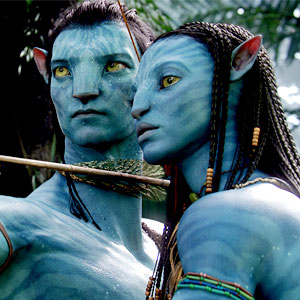
The story, as you’ve no doubt heard by now, is about a paraplegic Marine, Jake Sully (Sam Worthington), who is given a new lease on life while on a mission on Pandora, thanks to the “Avatar” program, which places him inside the body of one of the Natives, ostensibly to gain intel about their ways and force a compromise with the military and big business (the Na’vi live atop a giant deposit of a rare fuel source). As such, the film is a bit of a hero’s journey, a bit of a Pocahontas-style imperialists-vs.-peaceful Natives narrative, and a bit of a sci-fi dreamy Alice in Wonderland, what with its through-the-rabbit-hole transformation scenes from Jake’s real, damaged body to his new, lithe, towering, blue figure. Upon landing on Pandora, Jake runs in with Dr. Grace Sullivan (Sigourney Weaver, that tough yet womanly Cameron staple), the scientist in charge of the Avatar program and communication, as well as Col. Miles Quaritch (Stephen Lang), leader of the military presence on the planet, both of them working under the thumb of the giant corporation attempting to mine the planet of its “unobtainium,” led by Parker Selfridge (Giovanni Ribisi). Grace and the Na’vi are the good, peace-loving, environmentally conscious side of the equation; Quaritch and Selfridge are the bad side, bombastic adrenaline/explosion junkie and money-grubbing puppet of the shareholders, respectively. It’s all fairly neatly spelt out by Cameron in a few none-too-subtle lines of dialogue and few shadings of grey in the characterization; all that remains over the course of Avatar’s titanic running time is for Jake to decide where his loyalty really lies. The colonel promises him the use of his legs back if he succeeds in either convincing the Na’vi to leave or else forcing them out. But after meeting a sexy, wise, playful Na’vi local named Neytiri (a sultry Zoe Saldana) and learning her exotic language and thrilling culture and ways -- the depiction of which provides the bulk of the film’s scenes -- which side do you think Jake goes for when all is said and done?
It’s crucial that we have a hero we can believe in with an enterprise like Avatar. Luckily, Worthington is an immensely capable and appealing actor. His Jake is just interesting enough to make us want to watch him but just blank and simply drawn enough to make him a flexible, viable access point for the masses to Cameron’s brave new world of Pandora, the eyes through which we see this magnificent landscape. On second viewing, I was even more impressed with Worthington’s raffish charm and his palpable excitement each time he enters his Avatar body. The narration is also quite effective. Weaver is also appealingly tough but also (pun intended) graceful, justifying her status once again as Cameron’s go-to tough chick after Aliens. Saldana is the only other actor who really makes an impression, and she’s feisty, impetuous, and wise as Neytiri; although unlike, say, Andy Serkis in The Lord of the Rings movies, her performance does tend to get a little smothered by the technology rather than breaking through it in any astonishing way.
The other actors unfortunately don’t fare as well, especially up against the backdrops against which they are placed. The jungles of Pandora are extraordinarily well-executed visually, with little bits of plant life and exquisite glowing firefly-type creatures flitting around the edges of the screen and bigger, equally lavish creations (a giant beast with horns or a colourful flying pterodactyl-like creature) popping out at you from right in the middle. (The 3D screening on a regular-sized screen allowed me to see these numerous gorgeous details better, actually, than the IMAX version I saw initially, which was just huge and loud, if more immersive... one more reason I warmed up to Avatar just a little bit more on second viewing.) And the rituals of the Na’vi -- especially the communal healing/prayer assemblies and the scenes where Jake learns to ride a moody, stampeding land creature or an equally ill-tempered flying animal -- are often breathtaking. The 3D is mercifully not just a gimmick used for the director to throw things at the audience; instead it is used to deepen and enhance the world it has created, making it feel tactile and almost hyper-real. As such, Avatar is undoubtedly an intermittently thrilling spectacle, never less than competently made, with plenty of surface imagination; it is a good first step in utilizing this brand new cinematic technology.
But as much as it is often amazing to behold, it is also frustratingly predictable and even clichéd. Individual characters, except, perhaps, for Sully and Grace, never really materialize into tangible, real entities. As much as we feel for the Na’vi as a group forced out of its home, they never become much more than a symbol of the tragic beauty of nature on the brink of destruction, and none of the individuals of the tribe really stand out -- as much as Saldana, on paper, would seem to make an excellent muse for Cameron. The characterization of the military and big business figures is even more laughably bombastic and flat, ciphers there primarily to deliver Cameron’s tirades against the insensitive, destructive evils of, well, the military and big business. Ribisi’s Parker Selfridge is little more than a stooge of the shareholders, with little hesitation about bulldozing sacred trees for the sake of profits. And Lang is about the most clichéd, square-jawed, gung-ho army colonel seen in ages. Michelle Rodriguez's initially gung-ho, later fed-up, decidedly Rodriguez-like army chick is supposed to undergo a change of heart, but it is so sloppily delivered (She actually says, and I quote, something as cliched as "I didn't sign up for this shit.") and telegraphed that it never really feels organic. At least in something like The Lord of the Rings, you had conflicted villains like Gollum. The characterization in Avatar is straightforward, black-and-white, and, by and large, flat, which, when coupled with Cameron’s smack-over-the-head blatant environmental message (even Al Gore went about his business with more subtlety and elegance in An Inconvenient Truth -- only half kidding, there), means nothing much is ever really at stake and that there is never any doubt which side will and should win out in the end.
The scenes in the jungles of Pandora, breathtaking, enveloping, and beautiful, are achievements not likely to soon be matched. The sense of community, nature, and ritual captured by Cameron is fitfully engrossing. The battle scenes (with rampaging beasts, colourful flying creatures, gunner helicopters and planes, and some skilled, lithe, blue-skinned warriors who know how to wield a bow and arrow) are well staged and satisfying, logistically speaking. But all the money that went into this pet project isn’t worth a fig if it doesn’t sweep us up in an original world or hook us into complex characters whose personalities and fates haven't been already telegraphed in in advance. Avatar, in 3D, is an interesting and largely successful experiment, a fascinating novelty. With a capable hero, a durable if familiar story, and, of course, downright luscious visuals, it certainly glides pretty well for a two-and-three-quarter-hour epic; however, there is a reason it never quite soars nor embeds itself in your memory as firmly as it should. B